
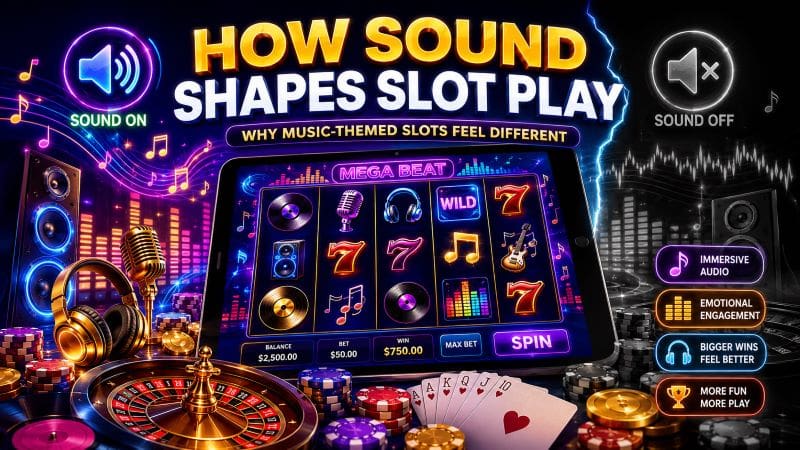
Most players have likely spun a music-themed slot machine with the volume turned off at least once. In many cases, despite having the same reels turning, the same symbols lining up, and the same paytable math, the experience feels like a completely different game. While the game still runs by the same rules and logic, there is a clear lack of something important. What was missing? And what would be missing in terms of the functionality of the gameplay? The answer is clearly the music-themed slot machine’s sound design. Many times we view sound design as simply a garnish on the gameplay. However, sound design, especially in music-themed slots, is very much a core component of the gameplay.
Once you begin to see how it functions, you will hear slot machines differently forevermore. I’ve spent my fair share of time around game audio — both as someone who enjoys playing slots for fun and someone who analyzes how games’ systems are built. My honest take on the matter is that sound design in slots is perhaps one of the most quiet and sophisticated forms of behavioral engineering present in casual gaming today.
The Psychology: how sound manipulates emotion & behavior
At the bottom of the reels, music-themed slots operate on a considerable degree of knowledge regarding how the brain responds to sound. Fanfares and win chimes used to celebrate winning combinations cause a release of dopamine and this isn’t simply marketing lingo; it’s how reward pathways within the brain react to expected and received rewards. A musical phrase rising in intensity followed by a bright, percussive chime tells your nervous system “good thing” before your conscious mind has even digested the numbers displayed on the reels. After enough repetition, the association occurs through auditory conditioning. Your brain starts associating certain tones, certain chord progressions and certain rhythmic patterns with reward and reacts to these sounds regardless of the final result.
The genius of music-themed slots lies in their ability to create illusions through sound. Near-misses are an example of this type of creativity. In many games with poor audio design, a near-miss is essentially nothing — no signal at all. In contrast, many music-themed slots create their own musical treatment for a near-miss – a shortened version of a win sound, a hopeful chord that never resolves. Psychologically speaking, this framing of failure as success primes players to continue spinning beyond where a visual near miss may not alone. Flow state: using audio to regulate pacing
Audio is used as a synchronization tool to regulate flow state. Reel-spinning sounds and that gentle mechanical whir and stop provide a sense of rhythm and pace. Players naturally tap into this rhythm as they click or tap to initiate each spin. If a slot developer breaks this rhythm with an unexpected sound or timing cue, they remove a player from flow state and therefore impact their ability to engage with the game.
As such, many sound designers focus significantly on transition audio – not just for the major events like jackpots but for everything in-between. All of this did not happen randomly. Real psychological priming is occurring due to frequency manipulation, pacing, and scheduled reinforcement. Each are based upon years of research related to how humans respond to variable reward and auditory stimuli. Some critics argue that this represents emotional manipulation. It does represent manipulating a player’s stress response and reward response according to a pre-planned schedule intended to optimize engagement.
Immersive experience/thematic synergy: music tells a story
Psychology helps explain why audio influences emotion and behavior. Thematic design explains why music-themed slots have been so popular in recent years. A slot machine developed around classic rock or 80s synth pop or fantasy movie scores is not simply placing a soundtrack above generic reels. Ambiance backgrounds establish an emotional tone prior to initiating a single reel spin. A jazz-themed slot opens with a smoky brushed drum loop featuring a walking bass line establishing intimate stakes in a late night setting. An arena-rock themed slot utilizes distorted guitar swells combined with crowd noise samples placing you between the front row and the stage.
None of these are neutral decisions. Where thematic synergy becomes really interesting technologically is when transitioning dynamically throughout a feature sequence. Modern slot engine audio do not merely display one looping track. Instead they layer stems (drums, bass, melody, pads), switch or add layers based upon the game status. When landing three scatter symbols and triggering a bonus round, the drums may increase in intensity prior to visually displaying the bonus round animation. The audio system is effectively anticipating the visual reward by a fraction of a second resulting in anticipation felt by the brain rather than reacting to the visual outcome. Environmental effects enhance this phenomenon by providing additional sensory inputs.
For example, on a record label themed slot machine incorporating vinyl crackle during spins provides subconscious input via environmental effects that enhances immersion. Similarly on a guitar theme-based slot machine prior to commencing a bonus round, you’ll hear guitar tuning creating another sensory input that players rarely consciously recognize while immersed within the game.
Audio branding takes this to its logical conclusion
Licensed games (games created based on authentic artist catalogs or specific films/franchise’s scores) utilize sound design as their primary differentiator from other slots available. Since licensed games utilize original recordings from authentic artists or franchises’ original scores, sound design becomes nearly synonymous with gameplay differentiation.
Gameplay pacing: how sound controls tension & excitement
Sound goes from providing atmospheric elements to functioning as control elements at this juncture. Sound impacts spin speed indirectly yet predictably because background music tempo and reel-stop sounds tempo dictate an implied rhythm that players follow instinctively. Faster paced loops during normal play tend to encourage faster spin cadences as players intuitively sync their tapping/clicking with the beat. Distinct rising tones or brief key changes alert players that they’re entering a new phase faster than any on-screen messaging can communicate.
Free spins soundtracks tend to replace base loops with faster-paced versions utilizing more instruments/padding/percussion; sometimes modulating upwards a couple keys; representing classic techniques for escalating without communicating anything verbally.
Jackpot sequence audio is arguably the most dramatic representation of this concept, tending to be multi-staged builds including held-tension chords paused briefly before releasing into full-fanfare. This pause is less significant than it appears. A second-long silence preceding large payouts maximizes the post-payout experience by employing the same principles a drummer employs leading into a cymbal crash. This is purely sound as reinforcement tool; the end-result is always known (the win/loss), however the emotional experience surrounding that outcome is influenced solely by timing-related choices made by an audio designer/engineer and not by mathematical considerations.
How the sound actually influences play patterns
The behavioral research supporting this claim demonstrates convincingly that studios continually invest in audio development as visual development slows.
Industry research (figures vary by title/platform/player segment; thus should be treated as general estimates) repeatedly finds that sessions lasting multiple hours occur significantly longer with sound enabled compared to those played with volumes reduced or muffled; with some studies indicating increases ranging from 40% – 65%. Average bets sizes and spin frequencies exhibit similar trends; spin speeds increasing between 20% – 25%, bet sizing sometimes increasing even greater depending upon which game/platform/player segment is being analyzed.
A few concrete instances that exhibit themselves repeatedly include:
- Sessions tend to last longer when played with sound; often substantially longer
- Perception of wins skew upward when audio is present; players commonly overestimate amounts won when win celebrations
- Accompany payouts; whether modest or otherwise.
- Distraction-reduction exhibits itself; immersive audio tends to narrow players’ focus towards the game itself and away from external
- Environments; many players report losing track of time more frequently when playing with full audio enabled.
- Although it does exist; there are numerous players who prefer not to have sound enabled (specifically those playing in public/shared areas or players who develop sensitivities toward perceived audio-manipulation behaviors).
- Repeat-play encouragement displays itself in retention statistics; operators study reports indicate that repeat visits correlate positively with games enabling sound.
- Spending/speed-of-play metrics receive most regulatory/research scrutiny as they relate directly to responsible-gambling concerns; as such when audio demonstratively increases spending rates and/or speed-of-play metrics; this is not considered neutral design outcomes; rather this represents behavioral levers.
- Increasingly, regulators in various jurisdictions require documentation describing how audio-design impacts these exact metrics.
Slots that get their soundtrack right
There are relatively few examples that are referenced repeatedly in industry forums as exemplars illustrating what can be achieved when developing an entire soundtrack around an existing artist/catalog. Both guns n’ Roses and Jimi Hendrix themed slots utilizing licensed material (catalog tracks rather than synthesized approximations) illustrate how easily identifiable music creates instant emotional connections for players.
Jazz/lounge style slots tend to succeed with ambiance-looping; many employ warm horn samples and brushed percussion that sustainable for extended periods without becoming grating — which is harder than it seems as a loop enjoyable for two minutes can quickly become annoying after twenty.
Electronic/EDM style slots capitalize heavily on dynamic music transitions — utilizing their inherent build/drop structures perfectly aligns with typical bonus-round pacing as EDM educates listeners on anticipating tension/reward release in exactly the manner described above.
Classical/orchestral style slots utilize narrative-based soundtracks that alter instrumentation/key throughout game phases as movies/fantasy stories do with character arcs. Occasionally rock-opera/Broadway adjacent style slots will attempt full vocal tracks synchronized to bonus rounds — representing high-risk/high-reward creative ambitions that yield extremely immersive sonic experiences within slots unachievable by means of mere instrumental loops.
Separating the successful examples from unsuccessful examples largely relies on whether the sound-design team worked collaboratively with game mathematics/designers/artists or if they were provided with completed builds asking them to compose music post-hoc.
Where craft meets concern
While none of these aspects make audio-design in slots inherently exploitative; many fans enjoy both atmosphere and craftsmanship involved in creating these experiences in much the same way audiences enjoy an excellent film score without perceiving it as manipulative.
It is worthwhile acknowledging two realities simultaneously:
1.) This represents an impressively robust discipline combining music-production/Psychology/user-experience-design
2.) This represents a discipline specifically engineered to influence player-behavior to benefit an operator’s profit margins.
Auditory conditioning/near-miss framing/tempo driven pacing etc., represent legitimate tools possessing quantifiable measures influencing Session-length/bet-size/spending-rates and knowing how these tools function offers practical utility whether you are an individual seeking more control over your personal habits or an individual attempting to create an honest experience.